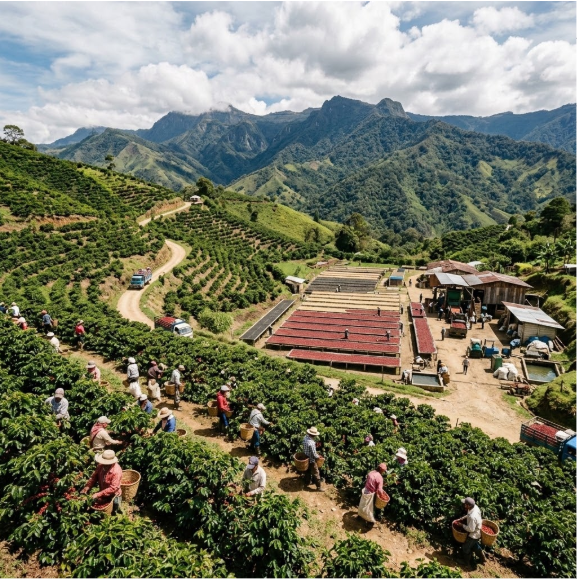
Biodiversity Credits in the Brazilian Coffee Supply Chain
Protecting and restoring nature at the scale the climate crisis demands will require moving beyond pilots to investable models that channel private, philanthropic and catalytic capital into measurable, durable biodiversity gains. Biodiversity credits are one of the most promising instruments for doing so — but only if they can be designed with the environmental integrity and financial credibility that institutional capital requires.
By connecting on-the-ground ecological rigor with the language of finance, the framework offers corporates, philanthropic funders and return, seeking investors a practical pathway to embed nature into agricultural value chains, and a template that can be adapted to other commodities and geographies where forests and production systems meet.
This report asks how biodiversity credits should be implemented in coffee supply chains, and how the approach can be generalized across agricultural landscapes on the forest frontier. It proposes a replicable three-phase roadmap — feasibility screening, stakeholder co-design, and MRV-based implementation — tested in Brazil’s Atlantic Forest coffee regions, one of the world’s most biodiverse and most threatened landscapes. It pairs this roadmap with a three-dimensional metric framework spanning endangered-species populations, pollinator diversity, and freshwater beta-diversity, giving buyers and investors a defensible basis for valuing outcomes.
The work grew out of the São Paulo School of Advanced Science (SPSAS) on Co-designing Biodiversity Assessments, led by Thomas Lewinsohn, Principal Investigator of the School and Professor of Ecology at the University of Campinas (UNICAMP), and Robin Chazdon, Professor Emerita of Ecology and Evolutionary Biology at the University of Connecticut.